|
|
|
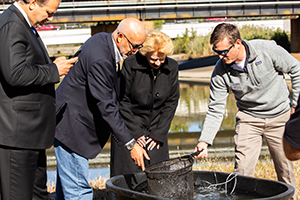
Signing ceremony
for Public Act No. 517. Governor Granholm along with Alliance
Officers and Members. |
The Alliance of Rouge Communities (ARC) is a voluntary public watershed entity currently comprised of 40 municipal governments (i.e., cities, townships, and villages), three counties (Oakland, Wayne, and Washtenaw) and the Wayne County Airport Authority as authorized by Part 312 (Watershed Alliances) of the Michigan Natural Resources and Environmental Protection Act (MCL 324.101 to 324.90106) as amended by Act No. 517,
Public Acts of 2004.
Officially formed in January of 2006, the ARC members represent
public agencies with water management responsibilities whose jurisdictional
boundaries are totally or in part located within the Rouge River
watershed located in southeast Michigan. The state law authorizing
the formation of watershed alliances throughout Michigan was modeled
after a Memorandum of Agreement (MOA) adopted
by the Rouge River watershed communities and counties in August
of 2003, which successfully guided a regional effort over a three
year period to address watershed-wide water quality and water quantity
issues.
The 2003 MOA was developed by the communities and the three counties
to respond to declining federal grant funds to Wayne County for
the Rouge River National Wet
Weather Demonstration Project that had supported watershed-wide
management efforts since 1993. During the three years of operation
under the MOA, the Rouge River watershed communities voluntarily
contributed nearly $900,000 to match available federal funding for
cooperative watershed management activities. The first year budget
for the ARC (2006) is approximately $600,000 with fifty percent
local and fifty percent federal funding.
Under the ARC bylaws
all cities, townships and villages as well as the counties located
totally or in part within the Rouge River watershed are eligible
for membership. Over 95 percent of the eligible communities and
counties have adopted the bylaws through formal action of their
respective governing authorities. In addition, the bylaws provide
for membership of other public entities in the watershed who under
state law are required to have a water discharge permit. Several
public agencies are still considering membership.
History
The Rouge River watershed, located in southeast Michigan, runs
through the most densely populated and urbanized land area in the
state. The watershed is approximately 438 square miles in size and
includes all or part of 48 municipalities in three counties, with
a population of over 1.4 million. The industrial growth of the lower
Rouge River in the first half of the twentieth century and the rapid
residential and commercial growth in the last half of the century
in the upper portions of the watershed created serious pollution
problems. Despite pollution control efforts as early as the 1940s,
when the Detroit wastewater treatment facility was built to serve
southeast Michigan including many of the Rouge River watershed communities,
pollution problems increased in the river. It has only been in the
last decade that significant restoration of water quality has begun
to be documented as a result of over one billion dollars of investments
by area residents for pollution control. Cooperative efforts at
the local level to restore the Rouge River began in early 1980s.
At the urging of local citizens and organizations the State of Michigan
adopted the Rouge River Basin Strategy in 1985. The following key
events have occurred over the last twenty years is the efforts to
improve the water quality of the river and restore beneficial uses
- 1987 – The International Joint Commission designated the
Rouge River as one of the 43 most polluted areas in the Great
Lakes
- 1989 – The first Rouge River Remedial Action Plan (RAP)
was completed and endorsed by a majority of the watershed communities
that has been updated periodically (2005
RAP Update)
- 1991 – The United States District Court, at the urging
of local communities, facilitated a phased process for correcting
combined sewer overflows (CSOs) affecting the river
- 1992 – With the bipartisan assistance of the Michigan
congressional delegation Wayne County received the first
U.S. Environmental Protection Agency grant for the Rouge
River National Wet Weather Demonstration Project (Rouge
Project)
- 1994 – The U.S. District Court for the Eastern
District of Michigan strongly urged the 48 local public
agencies within the Rouge River watershed to adopt a more
comprehensive approach to control pollution from sources
other than CSOs under the authority of the Michigan Drain
Code
- 1994 – As an alternative to the Michigan Drain
Code Inter-County Drain Authority proposed by the U.S.
District Court, and to comply with the pending U.S.
EPA storm water regulations, a group of local agencies
and communities within the Rouge River watershed proposed
a watershed-based approach to the control of pollution
sources related to storm water discharges
- 1997 – The Michigan Department of Environmental
Quality adopted the unique watershed approach to storm
water management developed and proposed by local agencies
participating in the Rouge Project that would subsequently
become a statewide alternative for meeting Phase II
federal storm water discharge requirements
- 2001 – A drafting committee, representing
watershed communities and the three counties in
the Rouge River watershed developed the framework
for a new watershed organization that would assist
the local governments meet the requirements of their
watershed-based, storm water NPDES discharge permits
- 2003 – Thirty-eight cities, townships
and villages and three counties within the Rouge
River watershed formed a partnership to address
their storm water permit requirements under the
terms of a Memorandum of Agreement
establishing the Rouge River Watershed Local
Management Assembly
- 2005 – The Rouge River Watershed Local
Management Assembly supported the passage of
state legislation to authorize local governments
to form watershed alliances that was subsequently
signed into law January 3, 2005 as Act
No. 517, Public Acts of 2004.
- 2006 – The Alliance of Rouge Communities
was formed under the new state laws and held
its first meeting in January
The Preamble to the Alliance
of Rouge Communities Bylaws provides a narrative description
of the events leading to the formation of the Rouge River Watershed
Local Government Assembly and its transition into the ARC.
Operational Funds and Purpose
The purpose of the Alliance of Rouge Communities (ARC) is to provide
an institutional mechanism to encourage watershed-wide cooperation
and mutual support to meet water quality permit requirements and
to restore beneficial uses of the river to the area residents. The
ARC Technical
Committee, in addition to design and review of the annual ARC
water quality monitoring program, develops materials to guide members
in meeting state storm water permit requirements, assists in the
development and implementation of technical training programs, and
serves as liaison with the Michigan Department of Environmental
Quality on storm water permitting issues including the development
of subwatershed management plans. The ARC
Public Information and Education Committee (PIE) develops public
information materials, sponsors workshops, and other public involvement
activities to encourage stewardship of the river, coordinates activities
with non-profit organizations and other public and private organizations
interested in building public stewardship of the river, and conducts
informational meetings for public officials to explain the role
of the ARC and the benefits of governmental cooperation in addressing
water management issues.
Funding for these activities as well as for the staff support of the
ARC and its committees is raised through assessments to members based
upon an allocation formula that gives equal weight to the population
and land area for community contributions and a similar weighted assessment
for non-community, public agency members. Local contributions are
used to match grant dollars that currently represent nearly fifty
percent of the annual ARC budget.
Governance
The ARC’s structure requires a full membership meeting at
least twice each year. Election of officers, adoption of the annual
budget and assessments to communities, major policy issues, as well
as any other formal action is reserved for the full membership meetings.
The ARC takes formal actions based upon a majority vote of its members
unless there is a call for a voting of member shares. The voting
shares are directly proportional to the annual assessments. The
Alliance elects three
officers (i.e., Chair, Vice Chair, and Treasurer) from among
its community members for two-year terms. The three officers, representatives
of each county, and elected representatives from each the seven
subwatershed groups comprise the ARC
Executive Committee that oversees the day to day operations
between the meetings of the full Alliance. In addition, the chairs
and vice chairs of the standing committees (i.e., Finance,
Public
Involvement and Education, Technical)
are appointed by the three officers. Standing committee membership
is available to all members. The members and chair(s) of the Organization
Committee are subject to approval by the full ARC and this committee
examines and recommends organizational and policies including consideration
of new public agency members and the designation of non-voting ARC
Cooperating Partners.
Monitoring Progress
As of August 2007, 40 communities, three counties and the Wayne County Airport Authority have adopted the ARC bylaws. This web site serves as the primary tool for disseminating information about the ARC. The web site is intended to provide information to all members on the status of activities and actions, and to provide interested citizens and organizations the ability to monitor progress of the ARC and identify meetings they may like to attend.
The Alliance of Rouge Communities and its predecessor organization
the Rouge River Watershed Local Management Assembly have accomplished
the following over the past five years
- Established a model for cooperative watershed approaches to
storm water management that resulted in a new statewide watershed
permit option for meeting federal and state storm water discharge
requirements
- Funded technical support and facilitation for seven Subwatershed
Advisory Groups that developed and implemented individual subwatershed
management plans that have become state and national models
for cooperative storm water management
- Prepared and distributed of materials/information/ideas
among members that have reduced the cost and increased the
effectiveness of pollution control efforts
- Reduced the cost of compliance with storm water permits
through the development of templates for required reports,
and support of joint activities including the development
and distribution of informational and educational materials
- Supported extensive cooperative river monitoring to
determine the effectiveness of various pollution control
activities (the river monitoring program is the most extensive
in the state and perhaps one of the most extensive in
the nation)
- Completed three comprehensive surveys of watershed
residents to evaluate the effectiveness of public information
and education efforts
- Organized and presented workshops for elected and
appointed officials
- Provided training for agency employees on required
illicit discharge detection and elimination efforts
- Advocated on behalf on members in support of
passage of Watershed Alliance legislation and
in discussions with the Michigan Department of
Environmental Quality to improve the efficiency
of permit requirements and increase the effectiveness
of storm water discharge permit requirements.
- Addressed the concerns of the U.S. District
Court that has overseen the pollution control
efforts in the Rouge River since the early 1970s
- Documented measurable improvements in the
Rouge River and restoration of beneficial
uses.
- Formed the first Michigan Watershed Alliance
under a state law developed and modeled
after the cooperative agreement designed
by Rouge watershed communities.
|
Last Updated: 04/7/08
Please address all comments and suggestions about the contents of this Web page to C. O'Meara.
The Rouge River National Wet Weather Demonstration
Project is funded, in part, by the United States Environmental Protection
Agency (EPA) Grants #XP995743-01, -02, -03, -04, -05, -06, -08 and
C-264000-01.
|